HKD 2,200,000 - 2,800,000
The jade cong is one of the most representative and prestigious ritual jades of the Liangzhu culture, which flourished more than five thousand years ago in the lower Yangtze River region around Lake Tai. The Zhouli records, “With the yellow cong, one honours the Earth.” As an important ritual object through which prehistoric communities sought to communicate with Heaven and Earth and worship deities, the jade cong also served as a symbol of power, identity and status among tribal elites. Characterized by its square exterior and circular interior, embodying the ancient cosmological concept of “round Heaven and square Earth,” the jade cong was frequently decorated with highly intricate animal-mask motifs. Its exceptionally fine linear carving represents one of the highest achievements of Neolithic jade craftsmanship in East Asia. Such ritual jades have long been highly prized by major museums and distinguished private collectors worldwide and occupy an important position in the international market for archaic Chinese jades.
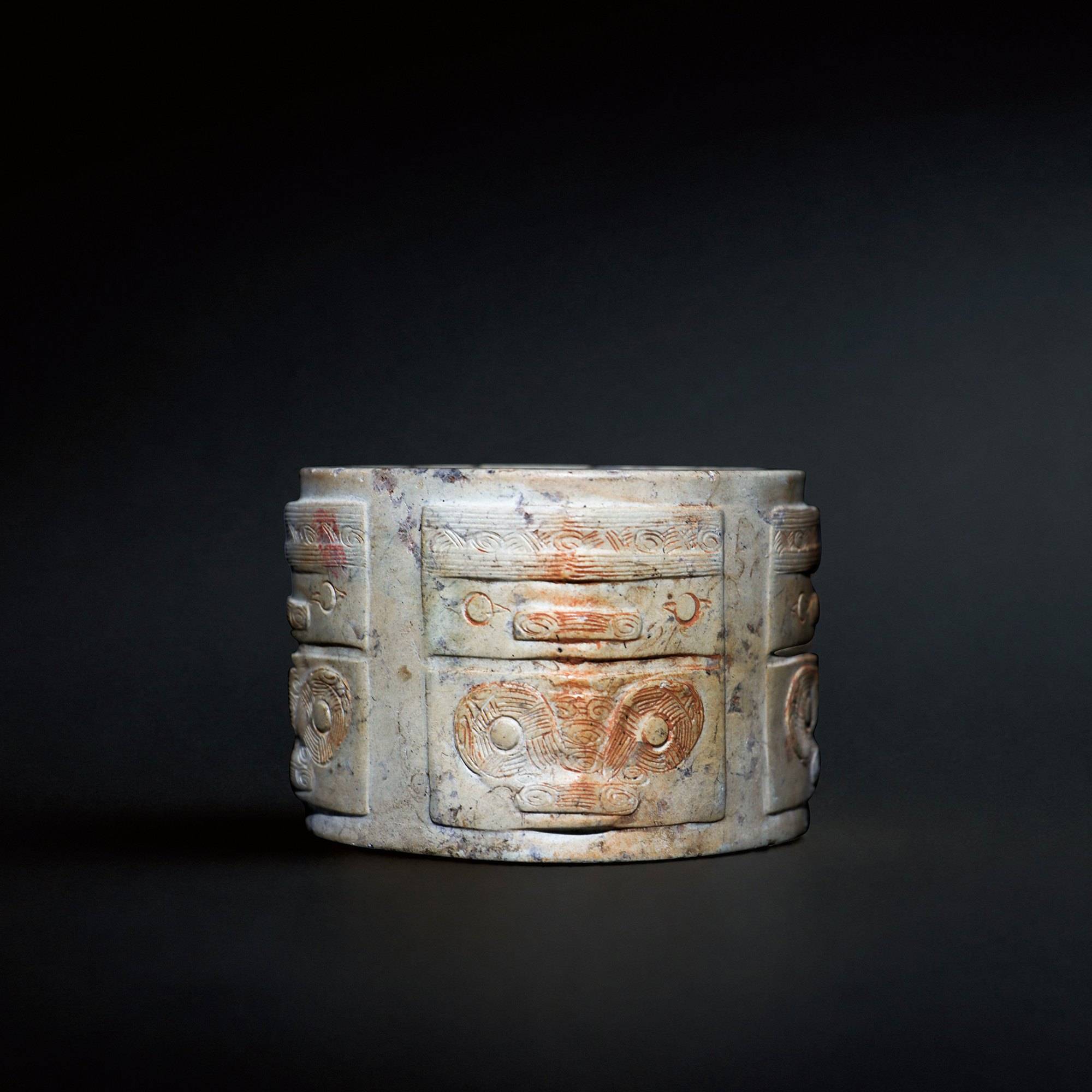
The present lot is a Liangzhu Culture jade cong with animal-mask decoration, belonging to the low, cylindrical form of the type. The exterior is subtly squared at the corners, while the interior is pierced by a continuous circular aperture. Solid and robust in form, it possesses an archaic and solemn presence, faithfully embodying the canonical prehistoric form of a jade cong with a rounded interior and squared exterior.
After more than five millennia, the jade has undergone extensive alteration and mineralization, developing the characteristic “chicken-bone white” calcification often associated with ancient jades. The surface displays a varied palette of greyish white tones interspersed with naturally formed blackish-brown iron and manganese staining. The layers of colour transition naturally across the surface, imparting a profound sense of age and archaeological character.
The four outer corners serve as the central axes of the decoration, dividing the exterior into symmetrical, regular rectangular raised sections. In its manufacture, Liangzhu craftsmen skilfully combined recessed-ground relief carving with exceptionally fine incised lines. The decorative registers are rigorously organized, with clearly defined layers and carefully controlled proportions.
The body is carved in shallow relief with multiple highly characteristic Liangzhu animal-mask motifs further articulated with fine incised lines. Each mask is arranged in two horizontal registers. The upper section features bands, curling lines and simplified eye motifs executed in dense and delicate linear carving. The lower section presents the characteristic divine-beast face, with raised circular forms representing the eyes and a broad horizontal nose and mouth, surrounded by dense feather-like incised lines. The motifs are executed with remarkable precision and continuity, resembling fine threads flowing across the surface, demonstrating the sophisticated lapidary techniques of Liangzhu craftsmen, who employed abrasive grinding and cutting methods in the working of jade.
After millennia of burial, extensive areas of the jade have developed a chicken-bone-white appearance, interspersed with grey-black and earthen-brown areas of alteration. The colouration penetrates naturally from the surface inward, forming subtle transitions without any sense of artificiality. A thick and lustrous patina covers the entire vessel, while the formerly sharp edges have been softened by the passage of time. The result is an intensely archaic character evocative of the remote antiquity of the object.
The circular aperture, drilled through the interior, has been finely smoothed, while traces of the original drilling and polishing techniques remain visible along the inner walls, providing valuable material evidence of Neolithic jade-working practices.
The present jade cong is preserved in good condition, with an elegant and subdued patina, clearly defined animal-mask decoration and powerful, assured workmanship. As one of the highest-ranking ritual objects associated with the origins of Chinese civilization, finely preserved archaic jades of clear cultural attribution and high artistic quality have long been especially sought after by leading museums and experienced collectors around the world. The present example possesses considerable scholarly and collecting significance.
References:
Across the Ages: Imitation and Innovation in Chinese Art, Hong Kong, 2006, no. 11.
Yang Boda, Ancient Chinese Jades from the Kwan Collection, Art Museum, The Chinese University of Hong Kong, 1994, no. 50.
Deng Shuping, Continued Collection of Exceptional Jades, Taipei, 1999, p. 100, pl. 26.